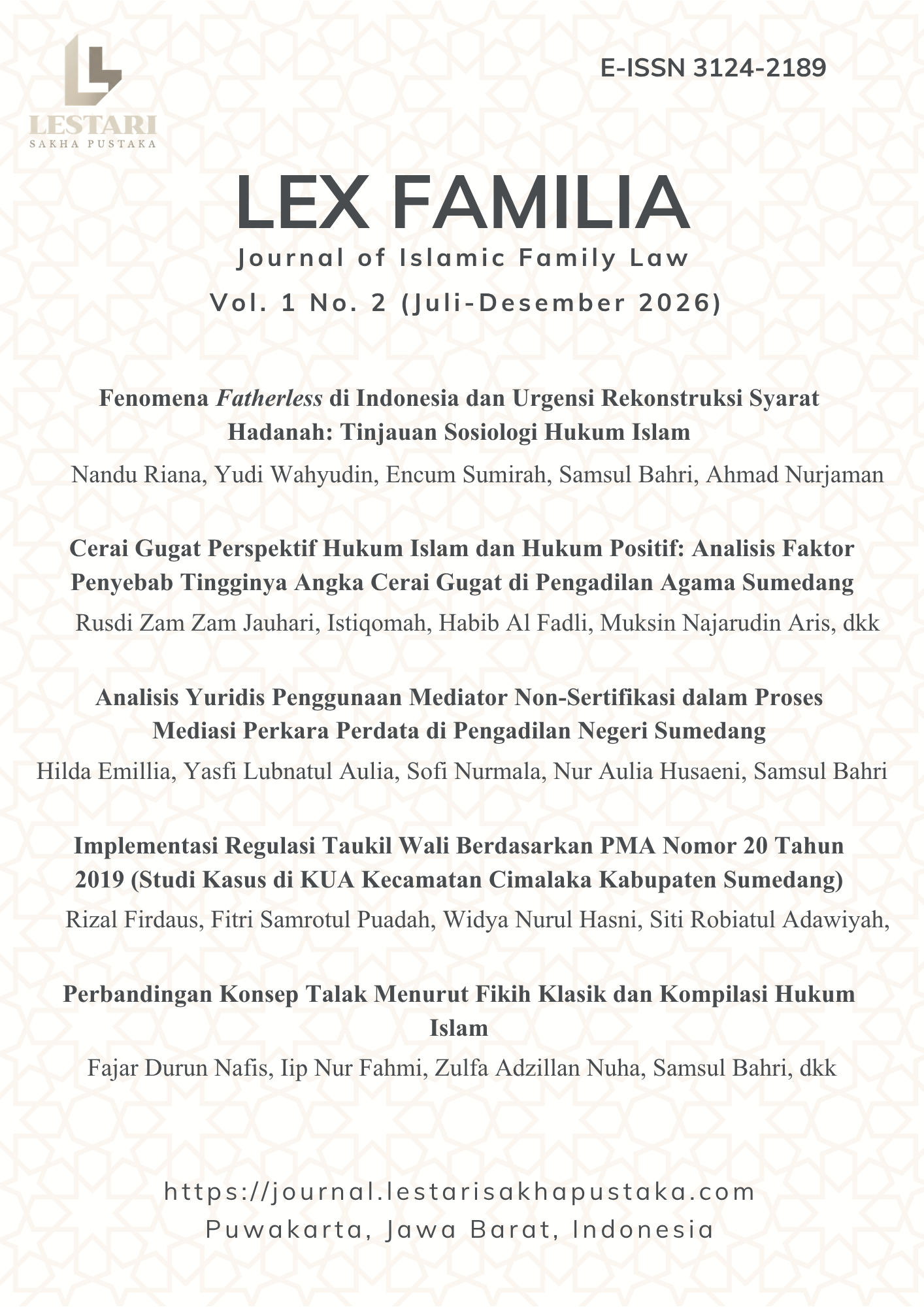
Fenomena Fatherless di Indonesia dan Urgensi Rekonstruksi Syarat Hadanah: Tinjauan Sosiologi Hukum Islam
Keywords:
Fatherless, Hadanah, Legal Reconstruction, Sociology of Islamic Law, Maqāṣid Sharī'ahAbstract
The fatherless phenomenon in Indonesia has become a concerning social problem, where many children grow up without the emotional and psychological involvement of their fathers in parenting. This study aims to: first, analyze the fatherless phenomenon and its contributing factors within the context of Islamic family law; second, examine the relevance of hadanah requirements in classical fiqh and Indonesian positive law to contemporary social realities; and third, formulate a reconstruction concept of hadanah requirements based on the sociology of Islamic law. This study employs a normative legal research method with a sociology of Islamic law approach, utilizing primary and secondary legal materials analyzed qualitatively through content analysis within the framework of maqāṣid sharī'ah theory. The findings reveal that the fatherless phenomenon is caused by multidimensional factors including divorce, irresponsible fathers, and emotional absence, which correlate with long-term psychological impacts such as midlife crisis. Article 105 of the Compilation of Islamic Law proves inadequate as it only regulates physical-material aspects of custody without incorporating indicators of parental emotional involvement. The proposed reconstruction encompasses three integrative dimensions: a normative dimension adding emotional and psychological involvement requirements, an institutional dimension implementing shared parenting models, and an implementative dimension developing post-verdict monitoring mechanisms, all grounded in maqāṣid sharī'ah and maslahah principles.
Downloads
References
Arrasyid, F., Pagar, P., & Tanjung, D. (2024). Islamic Family Law Reform in Indonesia Through Supreme Court Circulars: A Maqasid Sharia Perspective. Ulul Albab Jurnal Studi Dan Penelitian Hukum Islam, 6(2), 208. https://doi.org/10.30659/jua.v6i2.29236
Asni, A. (2021). Putusan Serta Merta Dalam Perkara Hadhanah Di Pengadilan Agama Dalam Rangka Perlindungan Anak. Al-Manahij Jurnal Kajian Hukum Islam, 15(1), 67–82. https://doi.org/10.24090/mnh.v15i1.4115
Badrudin, B. (2019). Implementasi Pasal 34 Uud 1945 Dalam Praktik Kehidupan Berbangsa Di Provinsi Riau (Perspektif Maqâshid Syarî’ah Tentang Nafkah Dan Hadhanah). Hukum Islam, 19(2), 1. https://doi.org/10.24014/hi.v19i1.7459
Efendi, Z. (2020). Pelaksanaan Eksekusi Hak Asuh Anak (Hadhanah) Terhadap Isteri Yang Murtad Dalam Perkara Nomor: 398/P.dt.G/2013/PA.Pbr Di Pengadilan Agama Pekanbaru). Teraju, 2(01), 1–34. https://doi.org/10.35961/teraju.v2i01.62
Fadani, F., & Alfarisi, M. A. (2024). Penalaran Aturan Hukum Perlindungan Identitas Agama Pada Anak Dalam Konsep Hadhanah Di Malaysia. As-Syar I Jurnal Bimbingan & Konseling Keluarga, 6(2). https://doi.org/10.47467/as.v6i2.6439
Haya, A. F., Kusmayanti, H., & Rubiati, B. (2023). Analisis Hukum Putusan Pengadilan Agama Pekanbaru Yang Menghapuskan Hak Pemeliharaan Ibu Terhadap Anak Angkat Karena Kelainan Seksual. Comserva Jurnal Penelitian Dan Pengabdian Masyarakat, 3(1), 73–84. https://doi.org/10.59141/comserva.v3i1.736
Kasim, F. M., Nurdin, A., & Ridhwan, R. (2021). The Sociology of Law Perspective on Child Protection at the Syar’iyah Court in Aceh. Gender Equality International Journal of Child and Gender Studies, 7(1), 70. https://doi.org/10.22373/equality.v7i1.8656
Kiara, R. T., & Bakri, K. (2022). Hak Asuh Anak (Hadhanah) Adopsi Pasca Perceraian Menurut Hukum Islam Indonesia. Reformasi Hukum Trisakti, 4(5), 1125–1140. https://doi.org/10.25105/refor.v4i5.15091
Muna, N., Anam, N., & Fatmah. (2024). Alternatif Penyelesaian Sengketa Sebagai Perlindungan Hak Anak Pasca Perceraian. Musawa Journal for Gender Studies, 16(1), 1–10. https://doi.org/10.24239/msw.v16i1.2382
Na’imin, N., & Mafiah, Y. (2024). Midlife Crisis Long-Term Psychological Effects of Fatherlessness: A Fiqh Hadhanah Perspective (Case Study in Temanggung). Jurnal Mediasas Media Ilmu Syari Ah Dan Ahwal Al-Syakhsiyyah, 7(1), 99–120. https://doi.org/10.58824/mediasas.v7i1.113
Rohmah, A. P., Suyaman, P., & Mulyanti, A. S. (2023). Determination of Custody Rights (Hadhanah) for Children Who Are Not Yet Mumayiz to the Father. Rechtsnormen Journal of Law, 1(2), 48–57. https://doi.org/10.55849/rjl.v1i2.307
Sarasanjaya, I. K. G., Wiratny, K., & Nurindahwati, Z. (2024). Implication of Condemnatoir Verdict in the Case of Child Custody Rights in the Legal Way of the Denpasar Agency (Case Study of Case No. 358/Pdt. G/2023/Pa. DPS). Indonesian Journal of Multidisciplinary Science, 3(11). https://doi.org/10.55324/ijoms.v3i11.980
Sururie, R. W., Hopipah, E. N., Witro, D., Diana, R., & Sopiyan, M. (2024). Co-Parenting Model in Resolving Child Custody Disputes in Urban Muslim Families. Petita Jurnal Kajian Ilmu Hukum Dan Syariah, 9(1), 250–268. https://doi.org/10.22373/petita.v9i1.277
Yahya, A., Rusli, R., & Akbar, M. (2021). Analysis of Judges’ Considerations in Deciding Child Care Case Against Apostate Wife. International Journal of Contemporary Islamic Law and Society, 3(2), 44–55. https://doi.org/10.24239/ijcils.vol3.iss2.34
Downloads
Published
Versions
- 17-07-2026 (2)
- 01-07-2026 (1)
How to Cite
Issue
Section
License
Copyright (c) 2026 Nandu Riana, Yudi Wahyudin, Encum Sumirah, Samsul Bahri, Ahmad Nurjaman

This work is licensed under a Creative Commons Attribution-NonCommercial-ShareAlike 4.0 International License.